|
Blocking the Sale of Federal Public Lands

What’s happening: During consideration of the One Big Beautiful Bill Act last year, the Senate was forced to consider a provision to sell up to three million acres of federal public lands to generate revenue to pay for their other priorities. I worked to build strong bipartisan opposition alongside lawmakers, states, counties, and sportsmen’s groups across the West. The Senate ultimately abandoned the provision. Under current rules, any senator could again propose expedited public land sales in a future budget reconciliation bill.
What I believe: Public lands make Colorado, Colorado. They’re foundational to our economy, and represent treasured parts of our communities, our geography, and our history. Congress must never use public land sales to fund short-term, partisan spending. Not now, not ever.
What I’m doing: On Thursday, I led Senators Jeff Merkley (D-Ore.), Ron Wyden (D-Ore), and Martin Heinrich (D-N.M.) in introducing the Public Lands Integrity Act. This bill would ensure that America’s public lands cannot be sold as part of a fast-tracked partisan budget process, which allows for passage in the Senate by a simple majority vote. I have long been a fierce champion for Colorado’s public lands and will continue to fight for the very thing that makes Colorado so unique.
2. Establishing a New Pathway to Secure Federal Disaster Relief

What’s happening: The Trump Administration has denied approximately 27 percent of Federal Emergency Management Agency (FEMA) disaster declarations nationwide, a nearly 72 percent increase in the rate of denials compared to previous presidential administrations dating to 2001. Last year, the Trump Administration denied Major Presidential Disaster Assistance for two disasters in Colorado – the Lee and Elk Fires in Rio Blanco County and major flooding in La Plata, Mineral, and Archuleta Counties. Trump provided no justification for the denials, despite FEMA documenting over $40 million in qualified damages and every member of Colorado’s Congressional delegation supporting the disaster declaration requests. Under current law, Congress has no authority to overturn a presidential disaster declaration denial and there is no requirement for the president to provide any justification for the decision.
What I believe: Disasters don’t care about state lines or politics, and neither should our President’s response. Following the Lee and Elk Fires and the flooding in Southwest Colorado last year, every single member of the Colorado delegation was united: our communities needed federal assistance. The President outright rejected our calls for federal support. Congress must be able to push past political retribution and help our towns and counties meet the challenge posed by natural disasters.
What I’m doing: On Wednesday, I led U.S. Senator John Hickenlooper and U.S. Representatives Raja Krishnamoorthi (D-IlI.), Joe Neguse, and Brittney Pettersen in introducing legislation that would allow Congress to override a presidential denial of federal disaster relief funding and create a new process to ensure states like Colorado are not left without support. Disaster relief should never be political, and I will continue to find tangible ways to combat this President’s egregious misuse of power.
3. Challenging EPA’s Disapproval of Colorado Regional Haze Plan
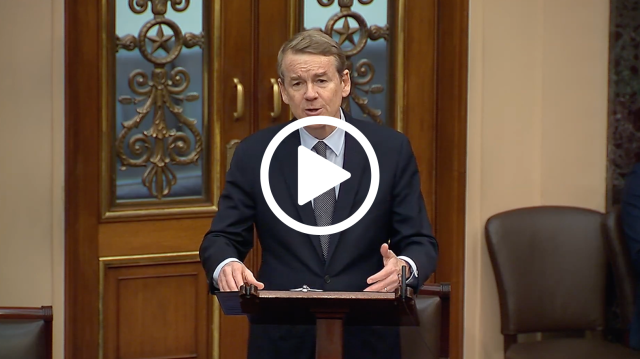
What’s happening: The Environmental Protection Agency (EPA)’s Regional Haze Program requires states to partner with the federal government to decrease visible pollution over national parks and wilderness areas. In 2022, Colorado submitted a good-faith Regional Haze Plan to EPA to improve the state’s air quality. This plan provided a range of solutions, including the voluntary, planned retirement of aging coal plants. The decisions to close these plants were driven by basic economics due to high maintenance and operation costs. Colorado incorporated those existing decisions into the state’s strategy to reduce air pollution. In January 2026, EPA disapproved Colorado’s entire plan because it included the closure of those plants. This decision was made — as explicitly said by EPA Region 8 Administrator Cyrus Western — as part of the Trump Administration’s efforts to ensure that no federal regulations stand in the way of coal-fired power generation.
What I believe: President Trump and his Administration have chosen to ignore economics and common sense, injecting federal politics into Colorado’s energy transition, and short-circuiting state-level negotiations. This Administration has rejected the model of collaborative government in pursuit of supporting coal-fired power generation - no matter the cost to Colorado families. This disapproval also makes it harder for Colorado to chart its own path on the energy transition, with Coloradans potentially paying tens of millions of extra dollars on their electricity bills to keep these outdated plants running. Colorado needs Congress to fight back against this attack on our state’s ability, and every state’s ability, to protect public health, ensure low-cost energy, and keep our air clean.
What I’m doing: On Wednesday, Senators John Hickenlooper, Sheldon Whitehouse (D-R.I.), and I forced a vote on the Senate floor on our Congressional Review Act challenge to the EPA’s disapproval of Colorado’s Regional Haze Plan. Sadly, Senate Republicans, once again, bowed to the Trump Administration and voted to undermine states’ rights and to reject the desires of local communities. This will not stop me from continuing to push for Colorado to choose its own path forward in the energy transition.
4. Fighting for Rural Healthcare Access
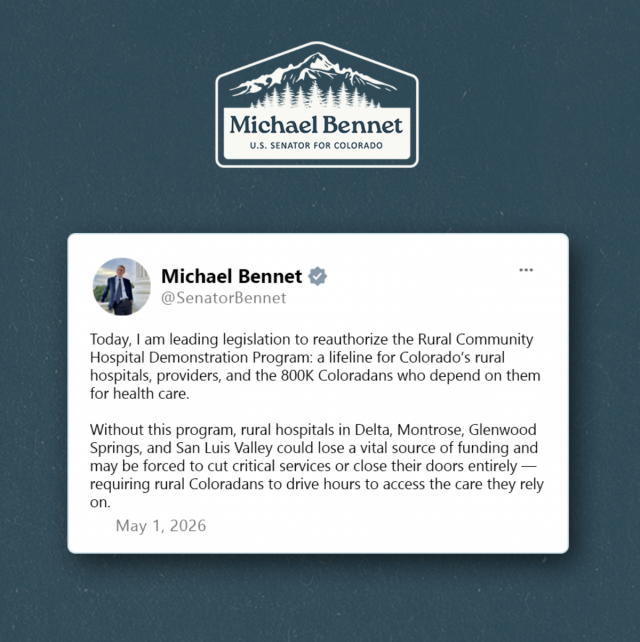
What’s happening: The Rural Community Hospital Demonstration (RCHD) program provides a lifeline to rural hospitals by allowing them to test innovative hospital payment models under Medicare to boost financial sustainability and to maintain and improve health care access in rural communities. RCHD has helped more than 50 rural hospitals across the country, including four here in Colorado, keep their doors open for acute inpatient care close to home. However, the RCHD authorization is set to expire in 2028, and participating hospitals have begun rolling off the program.
What I believe: Rural hospitals are the lifeline of their communities. They keep families healthy, support local economies, and make it possible for people to live and work in rural Colorado. At a time when many rural hospitals are already under significant financial strain, extending the RCHD is critical to maintaining access to care. If Congress fails to extend this program, hospitals not only lose a vital source of funding, but rural Coloradans could face longer drives, delayed care, and fewer options close to home.
What I’m doing: On Thursday, Senator Chuck Grassley (R-Iowa) and I introduced the Rural Community Hospital Demonstration Reauthorization Act which will extend the Rural Community RCHD program for another five years. I’ve heard directly from rural hospitals across Colorado about what’s at stake, and I’ll keep fighting to protect health care access for every Coloradan.
5. IN THE NEWS THIS WEEK
- This week, Senator Hickenlooper and I joined Senator Alex Padilla (D-Calif.) and 35 of our senate colleagues to introduce the Mail and Absentee Voter Protection Act. This bill blocks President Trump’s illegal and unconstitutional executive order that attacks Coloradans’ ability to cast mail-in ballots. Trump’s desperate attempt to undermine U.S. elections through this unconstitutional executive order is an insult to anyone who believes in the rule of law. Colorado has a gold-standard election system and consistently ranks among the states with the highest voter participation in the country. I will fight tooth and nail to protect every citizen’s right to vote by mail— Democrat, Republican, or unaffiliated. This Administration’s effort to disenfranchise voters must be stopped.
- On Tuesday, I joined Senator Elizabeth Warren (D-Mass.) and my Senate colleagues in reintroducing the Housing Survivors of Major Disasters Act. This legislation comes as the Trump Administration has weakened housing resiliency standards, gutted FEMA and its hazard mitigation programs, and denied and delayed disaster funding. Disasters are disasters, regardless of partisan politics. Coloradans know all too well how difficult it is to recover after catastrophic wildfires. When communities struggle to rebuild after increasingly severe natural disasters, we must come together and make it easier for them to access the housing aid they need to rebuild their lives.
- Wednesday’s Supreme Court ruling struck down a voting map in Louisiana that gives Republicans more power to redraw maps and weaken protections for communities of color, undermining hard-won voting rights. Trump’s Supreme Court continues to chip away at the Voting Rights Act, opening the door to voter suppression nationwide. Congress must act now by passing the John Lewis Voting Rights Advancement Act and the Freedom to Vote Act. We will never stop fighting for every American’s right to equal representation.
Click here to respond to this email.
    
Unsubscribe
|