|

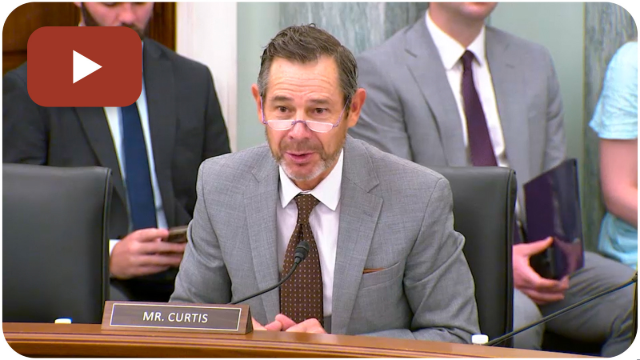
Senator Curtis praised the Commerce Committee’s bipartisan advancement of several online child safety bills, including the Children’s Health, Advancement, Trust, Boundaries, and Oversight in Technology (CHATBOT) Act, which he co-led. In delivered remarks, Curtis called the Committee’s action an important step toward giving families the tools they need to better protect children in an increasingly complex digital world.
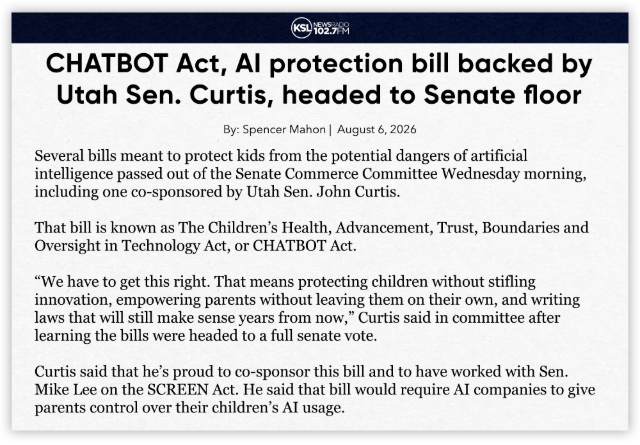
Full story by Spencer Mahon here.

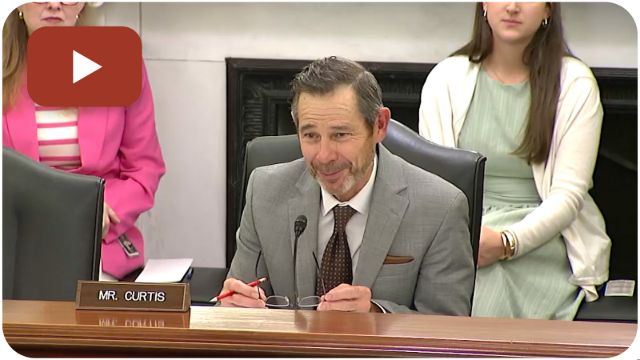
The Working Families Tax Cut Act, which Republicans secured into law last year, is directly supporting Utah’s farmers and ranchers. During a Small Business and Entrepreneurship Committee hearing featuring Utah Farm Bureau Federation President ValJay Rigby, Senator Curtis highlighted the challenges facing family farms and small businesses, emphasizing the need for commonsense tax policy, regulatory reform, and greater access to capital.
Despite having one of the strongest economies in the country, Utah faces a significant workforce shortage—particularly in agriculture, construction, and hospitality. A report published by the Sutherland Institute found that Utah “is experiencing one of the more severe workforce shortages among the states,” and “had a Worker Shortage Index of 0.72, meaning that there are 72 available workers for every 100 open jobs.”
To help fill that gap, Senators Curtis and Kelly (D-AZ) introduced the State Sponsored Visa Pilot Program Act, bipartisan legislation to create a new temporary visa pilot program that allows states to address their unique workforce and economic development needs while maintaining strong federal oversight and immigration enforcement.

The bill is pro-federalism and pro-growth. Instead of having the federal government entirely dictate who gets to come into the country, it hands that power to states—which understand their economic and workforce demands far better than Washington.
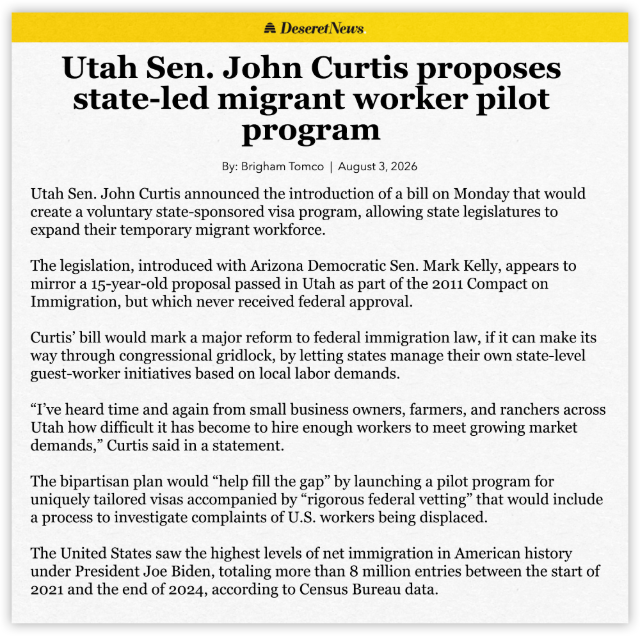
Full story by Brigham Tomco here.
Senators Curtis and Van Hollen (D-MD) introduced bipartisan legislation to confront the shortage of affordable housing across the country while helping to address funding shortfalls at the United States Postal Service. Amid record-breaking housing costs, the Delivering Americans Affordable Homes Act would allow local communities to lease Postal Service property rights for new housing construction.
China is carefully watching our response to Russia's war in Ukraine, inferring that our posture there would be similar to how we would respond if China were to invade Taiwan. We must continue to send a very clear message that the United States stands for freedom. In an interview with Radio Free Europe/Radio Liberty, Senator Curtis highlighted the overwhelmingly bipartisan support behind a Russia sanctions package that will target Putin’s war chest. The sanctions legislation passed the Senate with an 86-11 vote.
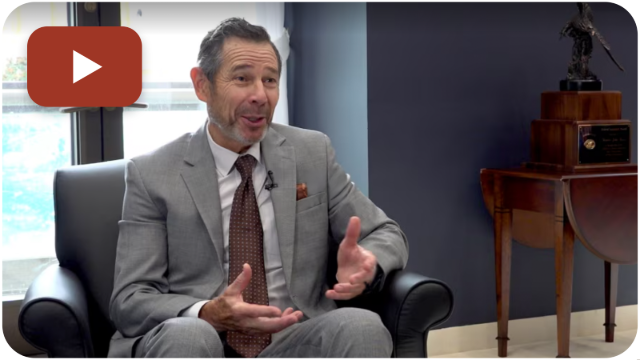
The Senate passed the Youth Poisoning Prevention Act, bipartisan legislation led by Senators Curtis, Duckworth (D-IL), Moreno (R-OH), and Baldwin (D-WI) to help prevent youth suicide by banning high-concentration sodium nitrite from being available to the public.
Since 2017, the National Poison Data System has shown a sharp annual increase in young adults ingesting the substance with suicidal intent. There is no recognized household or consumer use for high-concentration sodium nitrite, yet the sale of this dangerous substance by retailers remains unregulated, resulting in tragic consequences.
Extreme weather is taking a devastating toll on communities across the country. In Utah, we've seen firsthand the impacts of catastrophic wildfires and flooding. Senator Curtis joined his Senate colleagues and experts to discuss how we can better protect communities from natural disasters, including by passing the Fix Our Forests Act.
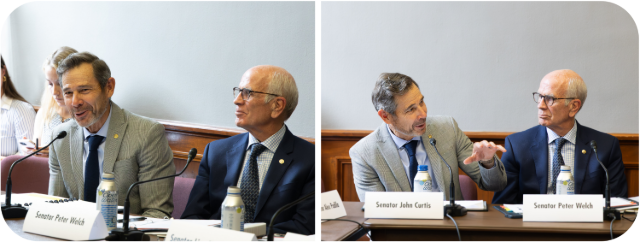
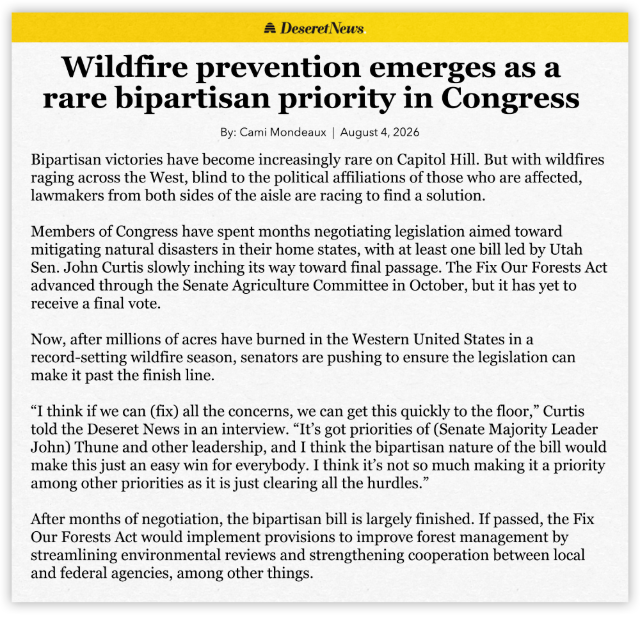
Full story by Cami Mondeaux here.
Senator Curtis shared the following statement in support of Todd Blanche’s confirmation:
“After having robust discussions with Todd Blanche and following his nomination process in the Judiciary Committee, I will support his confirmation. I’ve been pleased with his receptivity and understanding of the issues raised by my colleagues and me, including the anti-weaponization fund and a number of Utah-specific priorities. I look forward to working with him once confirmed.”
For decades, we have known the dangers of commercial asbestos, yet it has continued to be used. Senators Curtis and Merkley (D-OR)—Chair and Ranking Member, respectively, of the EPW Subcommittee on Chemical Safety, Waste Management, Environmental Justice, and Regulatory Oversight—introduced bipartisan legislation that would finally end all commercial and industrial uses of asbestos.
The Alan Reinstein Ban Asbestos Now Act protects public health by prohibiting the manufacture, processing, use, and distribution in commerce of all six recognized asbestos fibers, for which experts say there is no safe level of human exposure.

|